
Post-treatment & Curing are what truly "lock in" the results.
Small Tools, Great Craftsmanship: The Final Step That's Easy to Overlook
Surface treatment consists of three main stages: Pre-treatment, Core Treatment, and the final — and often overlooked — stage: Post-treatment & Curing.
We've previously covered sandblasting as pre-treatment, along with core treatment methods like painting, E-coating, and black oxide. But it's actually this final stage that determines whether a coating can truly stand the test of time.
After liquid painting, E-coating, or black oxide treatment is complete, parts must go through:
-
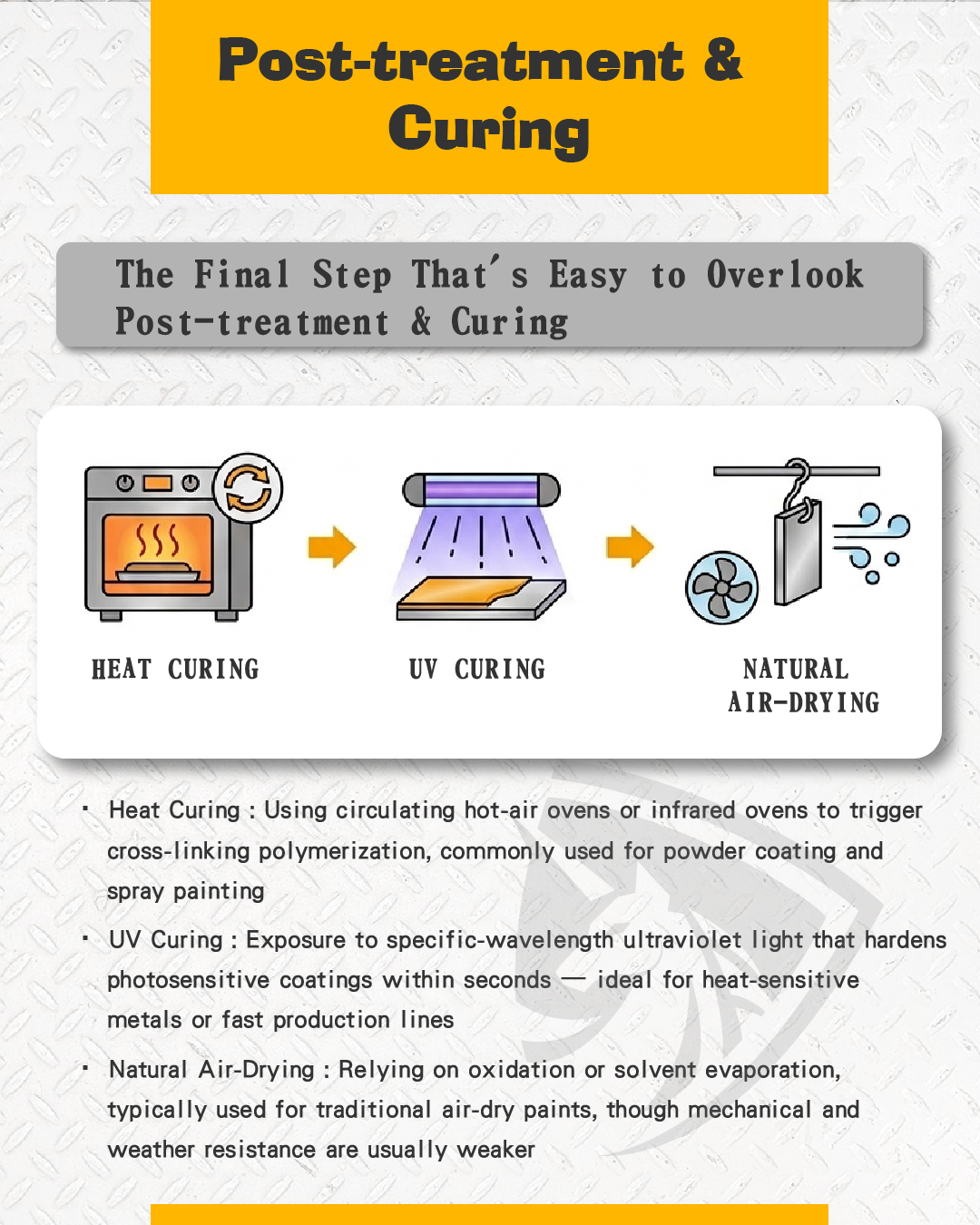
Heat Curing: Using circulating hot-air ovens or infrared ovens to trigger cross-linking polymerization, commonly used for powder coating and spray painting
-
UV Curing: Exposure to specific-wavelength ultraviolet light that hardens photosensitive coatings within seconds — ideal for heat-sensitive metals or fast production lines
-
Natural Air-Drying: Relying on oxidation or solvent evaporation, typically used for traditional air-dry paints, though mechanical and weather resistance are usually weaker
Choose the wrong curing method, and no matter how careful the earlier steps were, the coating may still fail to adhere properly, peel prematurely, or lack sufficient corrosion resistance.
Once curing is complete, parts must still pass quality checks — coating thickness, adhesion (cross-cut testing), wear resistance, and corrosion resistance (salt spray testing) — to ensure every finished product meets consistent, reliable standards.
Pre-treatment lays the foundation, core treatment shapes the finish, but curing and post-treatment are what truly "lock in" the results. This is exactly why E-Mark treats every stage with the same level of care.
#EMark #MetalProcessing #SurfaceTreatment #MadeInTaiwan
IT’S EXCELLENT MARK
◎ Evolutional
◎ Motivated
◎ Artistic
◎ Consistent
News Latest
Useful Links
Contact us
Tel: +886-4-7874565
Fax: +886-4-7874465
Email: sales-ek@emark.com.tw
Copyright © 2026 by E-mark Tools International CO.,LTD All Right Reserverd. | Designed by E-MARK